Why a Clear Route Through a Room Matters
A clear route through a room helps you spot awkward detours, protect activity areas, and decide which furniture to shift for easier daily movement.
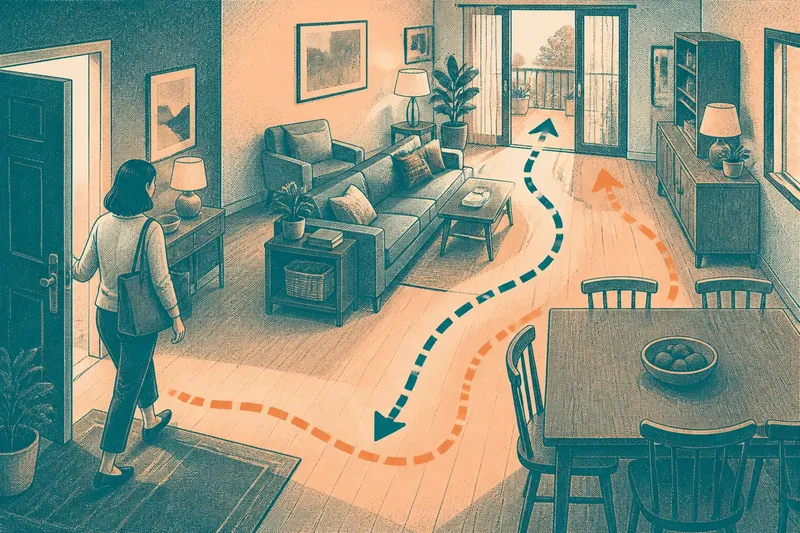
Where do you walk first when you enter a room, and where do you need to go next? A clear route through a room makes ordinary trips feel natural; an awkward one can reveal that furniture is working against the room’s purpose. Trace the paths people actually take before moving a sofa, table, or chair.
Think of a room as a small street network. Furniture shapes the available routes, the places people pause, and the parts of the room that stay easy to reach. The aim is not to leave every patch of floor empty, but to let important movements happen without unnecessary detours.
Start With Real Trips
Watch the room during an ordinary routine rather than judging it from the doorway. Someone might enter carrying a bag, cross to a window, sit down, then return to the hall. In a dining room, the route may run between the kitchen, the table, and a cabinet where dishes are kept. These repeated journeys matter more than a path that looks tidy on a floor plan.
Make a simple note of each destination and the route connecting it. Include doors, drawers, and seats that people use regularly. A line sketched on paper is enough; the useful part is identifying where the line bends, narrows, or cuts through an activity zone.
Notice whose routes count. A room may be shared by someone who moves quickly, someone carrying a laundry basket, or a child who tends to cut across the middle. A layout that feels straightforward to one person may require another to squeeze past a chair or ask someone to move. Consider the household’s actual habits, not an imagined ideal occupant.
Find the Pinch Points
Some obstructions are obvious: a chair blocks a doorway, or a cabinet drawer cannot open fully. Others appear only in motion. A route may technically exist but force a sharp turn around a table corner, send visitors behind a seated person, or make someone cross between the television and the people watching it.
Look especially at transitions. Can someone enter without immediately stopping to let another person pass? Can a person seated at the table get up without shifting a neighboring chair? Does a path to the window pass through the area where people stand to prepare food? A route can be open yet still interrupt the activity it crosses.
Door swings and movable parts deserve attention. An open door, pulled-out dining chair, or extended drawer temporarily takes up floor space. Consider the room in both its closed and active states; the route that seems clear while everything is tucked away may disappear once someone uses the furniture.
Do not treat every overlap as a flaw. In a compact room, one path may pass near several activities because there is no spare area to keep them apart. The useful question is whether people can still move and use the room without repeated negotiation.
Separate Passing and Pausing
Routes carry people through a room; activity areas invite them to stop. A sofa, desk, or dining table needs enough surrounding space for its intended use, while a passage needs to stay legible and accessible. When the two compete, someone may end up walking through the middle of a conversation or standing where another person needs to sit.
Try reading the floor as a sequence: entry, movement, pause, destination. If the route crosses the center of a seating arrangement, ask whether a different approach could run behind the sofa or along a wall. If the only way to reach a bookcase is through the space between two chairs, check whether their arrangement can leave a more direct opening.
Furniture does not need to line every wall to make a room work. A sofa set away from the wall can define a sitting area, but its back may also become an obstacle if it interrupts the main path from the entrance. The decision depends on what the room needs most: a protected conversation area, easy circulation, or both through a carefully placed gap.
Test the Furniture Map
Before making a substantial change, draw the room’s fixed features and movable furniture on paper. Mark doors, windows, radiators, and built-in storage, then sketch the routes that matter. This is not a technical plan; it is a way to notice whether a proposed arrangement sends people around an obstacle or through an activity.
For a quick physical check, use painter’s tape to mark the approximate edges of a proposed furniture arrangement on the floor. Walk the route yourself, then consider how it would work when a chair is occupied or a door is open. Keep the tape clear of delicate surfaces and follow the floor manufacturer’s care guidance if adhesion is a concern.
Say a hypothetical living room has an entry at one end and a balcony door at the other, with a coffee table directly between them. Household members regularly cross the room to reach the balcony. They shift the table toward the seating group and move a chair to open a path beside the sofa, then walk the route while the seating area is occupied. If they can reach the balcony without cutting through the conversation space or asking anyone to move, the change serves that trip; if not, they can return the chair to its earlier position and test another table placement.
When considering a new arrangement, change one major relationship at a time. Moving the sofa, table, and storage together can make it hard to tell which change helped. A small shift may open a route, while a large rearrangement may solve one crossing and create another near the entry.
Routes Through the Room?
How do I identify the main route?
Start at the entrance and name the destinations people use most, such as a seat, dining table, window, or storage cabinet. Trace the ordinary paths between them, including trips made while carrying something or opening a door.
Should every route be straight?
No. A gentle bend around a seating area can protect conversation while still making the destination easy to reach. A route becomes troublesome when its turns force people into an activity zone or make them repeatedly sidestep furniture.
What if the room is very small?
Prioritize the movements that happen most often and make their shared path as clear as the room allows. Flexible pieces, such as a lightweight side chair or nesting table, can be moved when a particular activity needs more room, provided they do not become new obstacles elsewhere.
How can I tell whether a route feels crowded?
Notice whether people brush against furniture, pause to let others pass, or change course to avoid disrupting someone seated. Those recurring adjustments are practical clues; the right response may be a furniture shift, a different use for a corner, or accepting a route that must serve more than one purpose.
Check the Room in Use
A clear route is not only a line across an empty floor. It must survive the room’s regular setup: chairs pulled out, a bag set down, a door left open, or a person standing at a counter. Return to the sketch or taped arrangement under those conditions, and watch for places where one ordinary action blocks another.
Also consider how the route feels to someone arriving as a guest. A direct path to a seat can make the room easier to understand, while an unclear route may send visitors through a private work area or leave them unsure where to pause. Furniture placement quietly communicates where movement belongs and where people are invited to stay.
A clear route through a room supports daily use without turning every trip into a detour. Trace the paths, identify crossings that interrupt activity, and adjust the furniture map with those specific moments in mind. A chair moved just far enough to open a passage can change how the whole room behaves, even if the room itself stays exactly the same.